 admin@playreo.in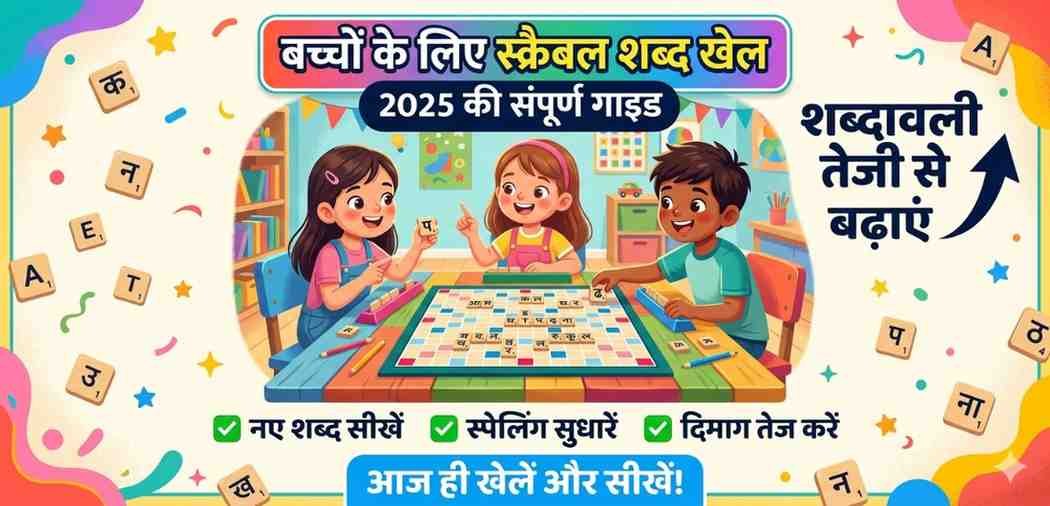
Introduction
If your child finds reading boring or struggles to remember new words, you’re not alone. Most parents feel stuck between workbooks and YouTube. But there’s one classic tool that genuinely works — the Scrabble word game for kids. It’s not just a board game. It’s a vocabulary builder dressed up as fun.
What Actually Is Scrabble — And Why Does It Matter for Kids?
Scrabble is a tile-based word game where players place letter tiles on a board to form words. Each letter has a point value, and the goal is to score as many points as possible. It’s been around since the 1930s, and there’s a good reason it’s still popular — it genuinely works for building language skills.
For children, the Scrabble word game for kids does something textbooks often fail to do: it makes word-building feel rewarding in real time. When a child places the word “JUMP” on the board and earns 15 points, that little win creates a memory. And that memory sticks better than any flashcard.
Unlike passive learning — watching videos or listening to someone read — Scrabble demands active thinking. A child has to look at their letters, think of possible words, consider spelling, and then make a decision. All of that happens within minutes, repeatedly, across an entire game session.
The Real Learning Benefits Behind the Scrabble Word Game for Kids
Let’s be direct: Scrabble is not just entertainment. When used regularly, it offers concrete educational benefits that parents and teachers have both noticed over time.
1. Vocabulary Growth That Feels Natural
Children naturally try to use longer or more complex words in Scrabble because those words score more points. This quiet competitive push means kids are constantly reaching for new vocabulary — not because a teacher told them to, but because they want to win.
Over a few months of regular play, most children show a noticeable improvement in the variety of words they use in both writing and speaking. That’s the Scrabble word game for kids doing its quiet work.
2. Spelling Gets Stronger Without Drills
Spelling exercises can feel punishing for kids who struggle. Scrabble sidesteps that frustration. When a child spells a word wrong and it gets rejected by another player, they correct it themselves — usually without getting upset, because it feels like part of the game, not a test.
This low-stakes correction loop is actually one of the most effective learning methods in educational psychology. Mistakes with immediate, gentle feedback create faster improvement than red pen corrections on a worksheet.
3. Critical Thinking and Pattern Recognition
Here’s something most parents don’t expect: Scrabble builds mathematical thinking alongside language. Kids learn to look at letter combinations, identify patterns, and calculate possible scores. They start to notice that certain letter combinations appear more often than others — QU, TH, ING, for instance.
That kind of pattern awareness directly supports reading fluency and comprehension. It’s an unexpected bonus of the Scrabble word game for kids.
“When a child discovers they can score 24 points with the word ZONE, they remember that word forever. Games teach better than lectures ever will.”
What Age Is Right for the Scrabble Word Game for Kids?
The standard version of Scrabble is typically recommended for ages 10 and up. But that doesn’t mean younger children can’t benefit. The key is choosing the right version or adapting the rules to fit your child’s level.
| Age Group | Recommended Version | What They Learn |
|---|---|---|
| Ages 5–7 | Scrabble Junior | Basic letter recognition, simple 3-letter words |
| Ages 8–10 | Scrabble Junior (Advanced Side) | 4–5 letter words, points awareness |
| Ages 10–13 | Standard Scrabble | Full vocabulary, strategy, scoring |
| Ages 13+ | Standard + Dictionary Mode | Advanced words, competitive thinking |
Scrabble Junior is a specifically designed version of the Scrabble word game for kids that uses a double-sided board — one side shows pre-printed words for younger children to match tiles to, and the other side works like a simplified version of the original game.
How to Introduce the Scrabble Word Game for Kids at Home
Buying the game is the easy part. Getting kids genuinely interested is where many parents get stuck. Here are a few practical approaches that actually work — not just in theory, but in real family settings.
Start with Short, Timed Sessions
Don’t try to play a full game in the first sitting. Children have shorter attention spans, especially for something unfamiliar. Start with 15–20 minute sessions where the goal is simply forming any correct word, not winning.
Once they get comfortable with the tiles and the board, longer games become something they look forward to — not something that feels like homework.
Let Kids Use a Physical Dictionary
One of the best habits you can build around the Scrabble word game for kids is dictionary use. When a word is challenged, let the child look it up themselves. This habit builds research skills and also makes kids feel ownership over the learning process.
You can also keep a small “new words notebook” nearby. Every time someone plays a word nobody knew before, write it down with its meaning. By the end of the month, that notebook becomes a personalised vocabulary book.
Play Without Score Pressure in Early Stages
Competitive scoring can be discouraging for beginners. In the first few weeks, consider playing “cooperative Scrabble” — where the whole family works together to form words, pooling tiles, and trying to fill the board as completely as possible. This removes the fear of losing and keeps the focus on vocabulary.
🎯 Quick Tips for Parents
- Keep sessions short early on — 15 to 20 minutes is enough for beginners.
- Celebrate new words, not just high scores. Praise the vocabulary, not only the points.
- Let children challenge your words too — it builds confidence.
- Rotate who goes first to keep things fair and reduce frustration.
- Introduce a weekly “bonus word” that earns double points if used in the game.
Digital vs. Physical: Which Version of the Scrabble Word Game for Kids Works Better?
This is a question that comes up a lot, especially since most kids today are on tablets and smartphones. There are good digital versions of Scrabble available — apps like Scrabble GO and browser-based word games offer convenience.
But for younger children specifically, the physical board game has some clear advantages. Holding and placing tiles develops fine motor skills. Sitting across a table from a parent or sibling creates genuine social interaction. And there’s no algorithm serving up easy opponents — real human competition requires real thinking.
That said, digital versions of the Scrabble word game for kids can be a useful supplement. On a long car ride or during school breaks, an app version keeps the vocabulary habit going without needing the physical set.
The smartest approach? Use the physical board at home for family game nights, and allow a digital version as an occasional bonus activity. Both serve the same learning goal from different angles.
Building a Vocabulary Routine Around the Scrabble Word Game for Kids
Games work best when they’re part of a consistent routine rather than a one-off activity. Here’s a simple structure many families have found effective:
Once a week family game night — dedicated Scrabble time, no screens, everyone participates. Even parents playing badly still model the learning behaviour.
Post-game word review — spend five minutes after each game discussing two or three words that came up. What do they mean? Can we use them in a sentence? This small step dramatically increases retention.
Over time, children who play the Scrabble word game for kids regularly start transferring what they learn into their everyday writing. Teachers often notice this before parents do — an improvement in essay vocabulary or class participation that traces back, quietly, to those family game nights.
You can complement this routine with resources from Merriam-Webster’s Word Games section, which offers free, beginner-friendly vocabulary challenges specifically designed for young learners.
Scrabble in Classrooms — A Growing Trend
Many schools have started incorporating Scrabble into their classroom activities — particularly in English language and literacy periods. The reason is simple: it covers multiple learning objectives at once. Spelling, vocabulary, strategy, turn-taking, and even basic arithmetic (scoring) all happen in a single game.
Some teachers run Scrabble clubs where students compete in small tournaments. This peer-based competition is often more motivating for children than individual study. The desire to beat a classmate drives vocabulary study in a way that no exam deadline can replicate.
If your child’s school doesn’t have a Scrabble programme, consider speaking to their English teacher about starting one. Many teachers welcome the suggestion — especially since the educational case for the Scrabble word game for kids is well supported by research on game-based learning. The Edutopia research on game-based learning outlines clearly why these approaches produce measurable academic improvements.
Common Mistakes Parents Make When Introducing Scrabble to Kids
Even well-meaning parents sometimes accidentally make the experience less enjoyable. A few things to watch out for:
Playing Too Competitively Too Soon
Children who feel consistently outscored lose interest quickly. Adjust your own play to be slightly challenging but not overwhelming. Let them win occasionally — not by losing on purpose, but by choosing simpler words yourself while they’re still learning.
Correcting Spelling in a Harsh Tone
When a child spells something wrong, the correction should feel like part of the game, not a reprimand. A simple “That spelling doesn’t work — want to try again?” keeps the mood light and keeps them engaged.
Skipping the Dictionary
Some parents avoid using the dictionary to keep the game moving faster. This is a missed opportunity. The dictionary habit is one of the most lasting benefits of the Scrabble word game for kids — skip it and you lose half the learning value.
You might also want to read our guide on the best English learning games for children in 2025 and our article on how to improve kids’ reading habits at home — both offer practical ideas that complement Scrabble nicely.
Final Conclusion
The Scrabble word game for kids is one of those rare tools that manages to be both genuinely educational and actually enjoyable. It doesn’t try to disguise learning as entertainment — it simply is both things at once, by design.
Children who play it regularly build broader vocabularies, develop stronger spelling instincts, and learn to think strategically about language. These are skills that show up in their schoolwork, their reading, and their confidence when speaking.
You don’t need a fancy setup or a formal programme. A board, some tiles, a family willing to sit together for an hour — that’s enough. Start small, stay consistent, and let the game do what it does naturally. The results tend to surprise parents who expected it to be just another activity.