 admin@playreo.in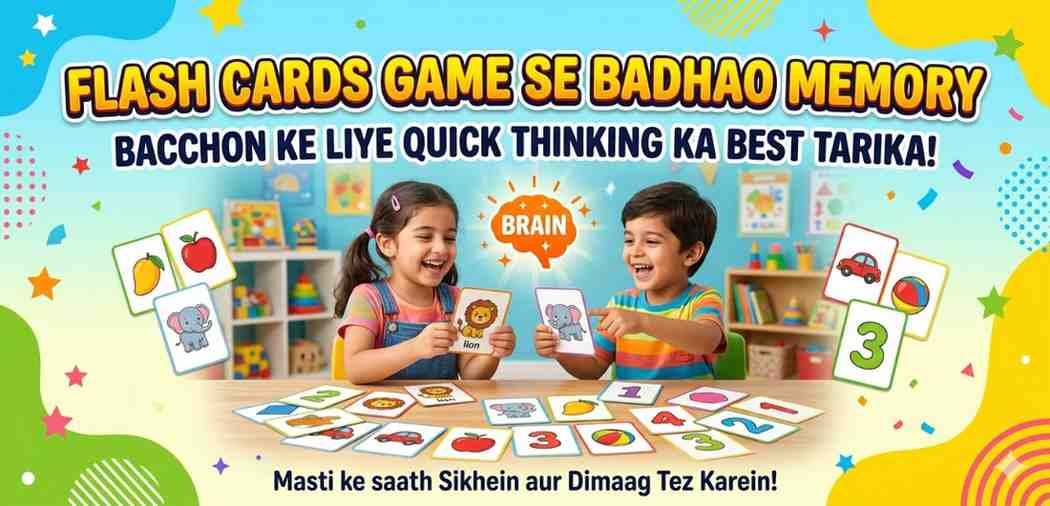
Most parents think memorization means sitting with a thick textbook for hours. But honestly, that rarely works — especially for young kids. The flash cards game is one of those genuinely practical tools that changes how children engage with information. It’s not a gimmick. It’s been used in classrooms for decades, and there’s a solid reason it keeps coming back.
In this guide, we’ll cover everything about the flash cards game — from how it actually works in a child’s brain to how you can use it at home without buying expensive kits.
What Exactly Is a Flash Cards Game?
Before getting into the benefits, let’s be clear about what we mean. A flash cards game involves small cards — physical or digital — each showing a question, word, image, or concept on one side, and the answer or explanation on the other.
You flash the card. The child responds. Then you reveal the answer.
That’s the core loop. Simple as it sounds, this rapid recall process is incredibly effective for building memory pathways. It’s not about cramming — it’s about active retrieval, which is very different.
Why Quick Thinking Matters in Early Childhood
Children’s brains are most adaptable between ages 4 and 12. During this window, repeated mental exercises don’t just teach facts — they actually shape how fast and flexibly a child can think.
Quick thinking isn’t just about answering fast. It’s about making connections, recalling information under mild pressure, and gaining confidence while doing it. A flash cards game creates exactly this kind of environment — low stakes, but genuinely challenging.
Think of it like a lightweight workout for the brain. Regular use builds mental speed the same way daily walks build physical stamina.
How Flash Cards Game Improves Memory
The Science Behind Recall Practice
When a child sees a card and tries to remember the answer before flipping it, the brain goes through something called active retrieval. Studies in cognitive learning consistently show that trying to recall information — even if you get it wrong — strengthens memory more than passive reading.
The flash cards game forces this retrieval every single round. Over time, responses get faster, and the information moves from short-term to long-term memory more reliably.
Spaced Repetition Without Realizing It
One of the smartest things about a well-designed flash cards game is that you naturally revisit difficult cards more often. Kids instinctively keep going back to cards they couldn’t answer.
This is called spaced repetition — a technique supported by memory research. Most children don’t need to know the term. They just experience the effect: things they struggled with yesterday become easy next week.
Types of Flash Cards Games You Can Try
Not all flash cards game formats are the same. Here are some that work well depending on the child’s age and learning goal:
1. Classic Question-Answer Format
Best for: Vocabulary, math facts, general knowledge.
Write a word or number problem on one side, the answer on the other. Time the child loosely — not strictly — to add a bit of gentle pressure without stress.
2. Image-to-Word Matching
Best for: Toddlers and early readers.
Show a picture of a cat, dog, tree, etc. The child says the word. This builds visual-verbal connections and works especially well for bilingual kids learning two languages at once.
3. Category Sorting Game
Best for: Ages 6 and above.
Spread several cards on a table. Ask the child to group them by category — animals, foods, colors, countries. This version of the flash cards game builds classification thinking, not just recall.
4. Story Chain Game
Best for: Creative and older kids.
Each card has a word or image. The child must use it in a sentence or connect it to the previous card’s word. This turns the flash cards game into a storytelling exercise and strengthens language skills alongside memory.
Making Flash Cards at Home – No Special Equipment Needed
You don’t need to order anything online to start. Here’s a simple DIY approach:
Take old visiting cards or cut white paper into small rectangles. On one side, write a question — like “What is 7 × 8?” or “Name the capital of France.” On the back, write the answer.
Start with 10 cards. Once your child gets those right consistently, add 5 more. Keep rotating out the easy ones.
The physical act of making the cards together with your child also helps. When kids help create the flash cards game material, they’re already learning before the game even starts.
Common Mistakes Parents Make With Flash Cards
Doing Too Many Cards at Once
Twenty or thirty cards in one session is too much, especially for younger kids. It turns the flash cards game into a chore. Start small — 8 to 12 cards max per session for children under 8.
Making It Feel Like a Test
The moment it becomes high-pressure, the benefit drops. Keep the tone light. Laugh when a wrong answer is funny. Celebrate correct answers simply — a clap, a “yes!”, nothing over the top.
Skipping Difficult Cards
It’s tempting to remove cards that a child keeps getting wrong. But those are the ones that need repetition the most. Keep them in the rotation. The flash cards game works precisely because it keeps bringing back unlearned material.
Flash Cards Game for Different School Subjects
For Mathematics
Multiplication tables, addition, subtraction — these are perfect for the flash cards game format. Kids who drill math facts with cards tend to develop faster mental math ability than those who only use written practice.
For Languages and Vocabulary
Whether it’s English, Hindi, or any regional language, vocabulary building through cards is highly effective. One side: the word. Other side: meaning and one example sentence.
You can also check resources like ReadingRockets.org for printable vocabulary card templates that are classroom-tested and free.
For General Knowledge and Science
Animal names, planets, body parts, historical events — the flash cards game format works surprisingly well for science and GK prep too. Kids often retain information better when it comes through a game rather than a textbook.
For cognitive development research supporting active recall methods, the Learning Scientists provide accessible, research-backed reading for parents and teachers.
Digital vs Physical Flash Cards – Which Is Better for Kids?
Both have their place. Physical cards have a tactile element that younger children respond to better — flipping a card, holding it, writing on it. There’s something about the physical action that reinforces memory.
Digital apps are more convenient for older kids and make spaced repetition automatic. But for children under 10, physical cards generally create better engagement and less distraction.
If you’re using an Android device with your child, there are basic flashcard apps that work well. But honestly, homemade cards often outperform apps for early learners because the process of making them involves the child directly.
You might also find our related guide on building study habits for school-age children and screen-free learning activities for kids helpful if you want to expand beyond flash cards.
How Often Should Children Practice?
Consistency beats intensity. A 10-minute flash cards game session every day is far more effective than a one-hour session on weekends. The brain consolidates learning during sleep, so short daily sessions across a week produce noticeably better retention than marathon study sessions.
For preschoolers: 5–8 minutes is enough. For primary school kids: 10–15 minutes works well. For older kids: Up to 20 minutes, but keep it varied.
Final Conclusion
The flash cards game is not a magic fix but it is a genuinely reliable, research-supported method that parents can use without spending money or requiring special skills. What makes it work is consistency, the right card count, and keeping the atmosphere positive.
Children who grow up with regular retrieval practice tend to feel more confident answering questions, whether in a classroom or in everyday conversations. The mental habit of quick, confident recall becomes part of how they think. Start simple. Make a few cards tonight. Play for ten minutes. You’ll likely see engagement that surprises you and results that build quietly but steadily over time.