 admin@playreo.in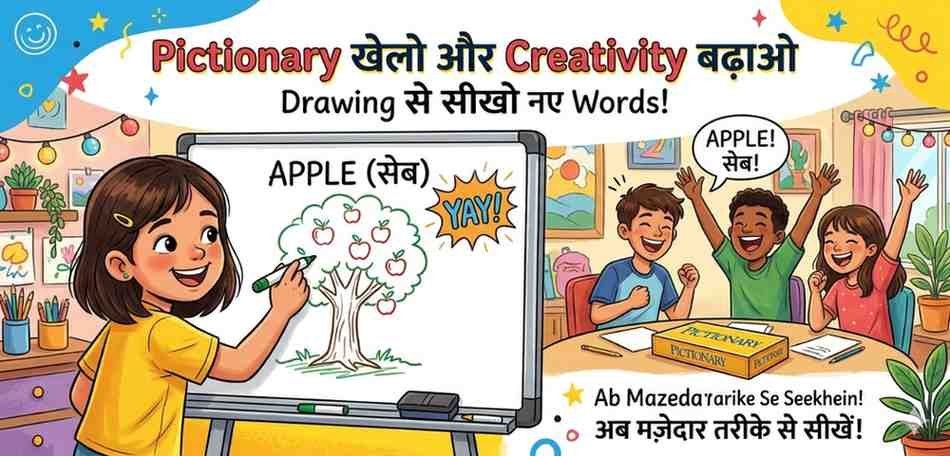
If you’ve ever struggled to remember a word you studied just yesterday, you’re not alone. Vocabulary doesn’t stick when you only read it in a list. But the Pictionary game for learning new words flips that problem completely — instead of reading, you draw. And that small change in approach makes a surprisingly big difference.
This guide is for anyone who wants to actually enjoy the process of building vocabulary, whether you’re a student, a working professional, or just someone who wants to communicate better in English.
What Exactly Is Pictionary and Why Does It Involve Drawing?
Pictionary is a word-guessing game where one person draws a picture based on a word or phrase, and others try to guess what it is — without the drawer speaking. That’s it. No hints, no spelling, just sketches.
It sounds simple, almost childish. But the learning that happens inside that game is anything but simple.
When you try to draw the word “jealousy” or “migration,” your brain has to think hard about what that concept actually means. You can’t just memorize the definition — you have to understand it well enough to show it visually. That’s a completely different level of thinking.
How the Brain Responds Differently to Drawing vs. Reading
Here’s something that might surprise you. When you write a word down ten times, your brain treats it as repetition — like a background task. But when you draw something connected to that word, your brain activates the visual cortex, memory centers, and creative regions all at once.
Researchers who study learning and memory call this the “picture superiority effect.” The idea is that images are stored more durably in memory than words alone. So when you connect a word to a picture you created yourself, it becomes much harder to forget.
This is exactly why the Pictionary game for learning new words works so well. You’re not just seeing the word — you’re creating something around it.
Using Pictionary on Your Android Phone
You don’t need a whiteboard or a group of friends to get started. There are several apps on Android that let you play solo or with others online. Apps like Skribbl.io (available via browser on mobile), Draw Something, or even the Google Jamboard app can be used to replicate the Pictionary experience.
Here’s a simple setup you can try tonight:
Open any drawing app on your Android phone. Write down ten words you want to learn this week. For each word, set a one-minute timer and draw whatever comes to mind when you think of that word. Don’t worry about the quality of the sketch — nobody’s judging your art skills here.
After drawing, write the word beside the image and read it out loud. Then, tomorrow, look at the drawing without the label and try to recall the word. You’ll be surprised how often it comes back to you immediately.
H2: Why Creativity and Vocabulary Are More Connected Than You Think
Most people treat creativity and vocabulary as two separate things. One is for artists, the other is for writers or students. But in reality, they feed each other constantly.
When your vocabulary is strong, you can describe creative ideas more precisely. And when you practice creative activities like drawing, your brain becomes more flexible in finding connections between ideas — which is exactly what helps you remember new words.
The Pictionary game for learning new words sits right at that intersection. It forces you to think creatively AND linguistically at the same time.
H3: A Practical Example Using Everyday Words
Let’s take three common words that people often confuse: transparent, translucent, and opaque.
Reading dictionary definitions of these three words takes about 45 seconds. But they’re easy to mix up later.
Now imagine drawing them. For transparent, you draw a clear glass. For translucent, you draw frosted bathroom glass with a blurry shape behind it. For opaque, you draw a solid brick wall.
Once you’ve drawn those three images, those words are unlikely to confuse you again. You’ve built a visual anchor for each one, and your brain will use that anchor whenever the word appears.
H2: Building a Weekly Vocabulary Habit With Pictionary
Habit-building is the boring part of learning that nobody wants to talk about. But it’s the part that actually produces results.
Here’s a weekly structure that works well:
Monday & Wednesday – Pick 8–10 new words from any source (a book, a news article, a YouTube video). These are your drawing words for the week.
Tuesday & Thursday – Use your Android phone or paper to draw each word. Spend no more than 90 seconds per word. Quick sketches are fine.
Friday – Play a short Pictionary session. This could be with a friend over a video call, or just a solo review where you look at your drawings and try to recall the words without looking at the labels.
Weekend – Use those words in actual sentences. In a message to someone, in a journal, or just speaking them out loud.
This structure makes the Pictionary game for learning new words part of your regular routine rather than a one-time novelty.
H2: Group Play Makes Learning Even More Effective
Doing this alone is good. Doing it with others is better.
When you play in a group — even virtually — you get the added benefit of other people’s interpretations. Someone might draw “freedom” as a bird flying out of a cage. Another person might draw it as an open road. Those different visual interpretations expand your understanding of the word beyond a single meaning.
Group Pictionary also creates light social pressure, which helps with focus. When it’s your turn to draw and everyone is watching, your brain goes into high-attention mode. Words learned under mild emotional engagement tend to stay longer.
If you’re an Android user, you can organize a quick session with friends using any group video call app combined with a shared whiteboard tool. It requires about zero preparation and can be done in under 30 minutes.
H2: Common Mistakes People Make When Using Pictionary for Learning
A few things can reduce how effective this approach is.
Drawing too slowly. If you spend five minutes perfecting a sketch, you lose the spontaneous thinking that makes drawing useful. Stick to quick, messy images.
Choosing only easy words. If you only pick words you already know, there’s no real learning happening. Push yourself to include at least three or four genuinely unfamiliar words each session.
Skipping the recall step. Drawing is only half the process. Looking at the image the next day and trying to recall the word without the label is where the real memory-building happens.
H2: Pictionary Game for Learning New Words – Is It for All Ages?
Absolutely. In fact, it might work even better for younger learners. Children between the ages of 8 and 14 often struggle with abstract vocabulary precisely because they can’t visualize it. Pictionary gives them a tool to make abstract ideas concrete.
For adults, it breaks the monotony of traditional study methods and reintroduces a sense of play into learning — something most of us lost somewhere in school.
You can read more about visual learning techniques at Edutopia’s guide to multiple intelligences and explore vocabulary research at Vocabulary.com’s research section for a deeper understanding of how word retention works.
Also, if you’re looking for related reading on how drawing supports memory, check out our guide on creative study techniques for Android learners and our post on visual vocabulary apps for beginners — both of which pair well with this approach.
Final Conclusion
The Pictionary game for learning new words isn’t a trick or a shortcut. It’s a genuine shift in how you engage with language — from passive reading to active creation. When you draw a word, you own it in a way that a flashcard never quite allows.
Whether you play it on your Android phone, on paper, or over a video call with friends, the process is the same: think, draw, remember. It’s slow at first. But after a few weeks of consistent practice, you’ll notice that new words arrive in your mind with a picture attached — and that picture makes them nearly impossible to forget.
Give it one honest week. Ten words, drawn badly, reviewed the next day. That’s all it takes to see whether this approach works for you.