 admin@playreo.in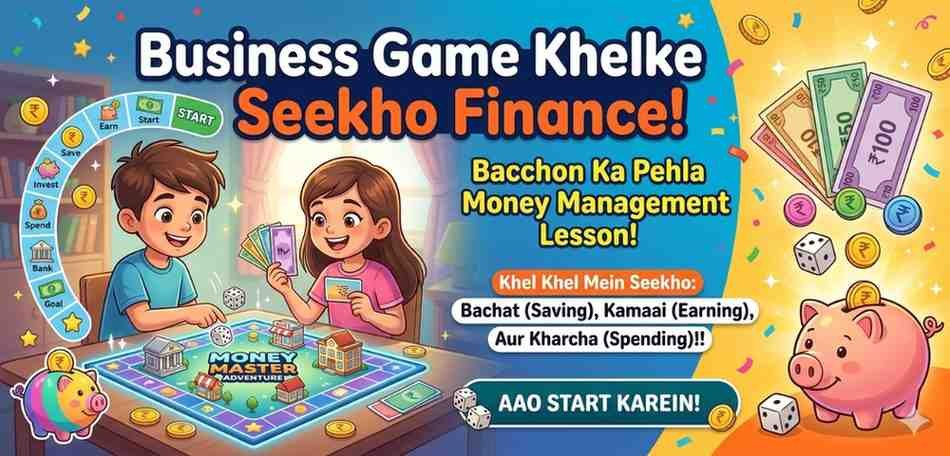
Introduction
Most parents worry about their children’s financial future. But very few actually sit down and teach money skills early. The good news? You don’t need a finance degree or a complicated textbook to start. Business game khelke seekho finance — this simple idea has quietly become one of the most practical approaches to helping children understand money before they even enter a classroom.
This isn’t just a catchy phrase. It’s a real method that works.
Why Traditional Money Lessons Don’t Stick With Kids
Think about it. If you tell a 9-year-old to “save money for the future,” they’ll nod and forget it by the next morning. That’s not because kids are careless. It’s because abstract concepts don’t register easily at that age.
Children learn best through doing — through games, simulations, and hands-on experiences.
When a child plays a business-style game, they’re not just moving tokens on a board. They’re making real decisions about buying, selling, saving, and losing. That experience creates memory. And memory creates habits.
What Does “Business Game Khelke Seekho Finance” Actually Mean?
Simply put, business game khelke seekho finance means learning financial concepts by playing games that simulate real-world business and money situations.
These games don’t have to be expensive or fancy. A classic board game, a simple Android app, or even a made-up family activity can do the job perfectly.
The idea is to expose children to financial choices in a low-risk environment. They can make mistakes, lose pretend money, restart, and try again. That’s where the actual learning happens — not in the failure, but in the thinking before the next move.
Types of Games That Teach Finance to Children
H3: Board Games With Real Financial Concepts
Games like Monopoly, Business (the Indian board game), and Cashflow for Kids are classic tools that have taught money basics to children for decades.
In these games, children deal with property buying, rent collection, loan repayments, and bankruptcy. They experience the joy of earning and the sting of bad financial decisions — all without any real-world consequences.
Playing these even once a week can build a surprisingly strong foundation.
Mobile and Android Apps for Finance Learning
In 2025, almost every child has access to an Android phone or tablet. There are dozens of apps available on the Google Play Store that are specifically designed for financial education.
Apps like Bankaroo, iAllowance, and PiggyBot let children track virtual money, set savings goals, and understand simple budgeting. These are not games in the traditional sense, but they gamify money management in a way kids actually enjoy.
If you’re looking for a deeper simulation, games like Hay Day or Farming Simulator teach resource management and profit thinking in surprisingly effective ways. You can explore age-appropriate financial learning apps here via Common Sense Media.
The Core Financial Ideas Kids Learn Through Games
When children seriously engage with business game khelke seekho finance activities, they naturally pick up several important money concepts.
Budgeting: Every game with limited resources teaches you that you can’t spend everything at once. Kids internalize this without being lectured.
Risk and Reward: Should I invest in this property or save my money? That question comes up in every business game, and kids genuinely wrestle with it.
Debt: Borrowing from the bank in Monopoly, and then struggling to pay it back, is a powerful early lesson about how loans work.
Income vs. Expenses: When your rent income is less than what you owe, you understand cash flow — sometimes better than adults do.
How Parents Can Use Business Games as Teaching Moments
Playing a game is one thing. Using it to actually teach finance is another.
The trick is to pause during the game and ask questions. Not to lecture, but to make your child think.
“Why did you decide to buy that property right now?” “You just lost all your money. What would you do differently next time?”
These simple questions turn a 30-minute game session into a genuine business game khelke seekho finance lesson. Children reflect on their choices, and that reflection is where understanding grows.
Don’t correct them immediately. Let them figure it out. The frustration of losing is actually part of the curriculum.
Real-Life Activities That Reinforce These Lessons
Games work best when they’re connected to real life. Here are a few activities that complement game-based learning:
Pocket Money Tracking: Give your child a small weekly allowance and ask them to track it in a notebook or an Android app. Seeing where their money goes is a powerful habit-builder.
Mini Family Business: Ask your child to plan a small event — maybe a lemonade stand or a small craft sale during a school fair. Let them price items, manage costs, and calculate profit. This turns business game khelke seekho finance from virtual to real.
Grocery Shopping with a Budget: Next time you visit a local market, give your child ₹100 and a list of things to buy. Watching them make trade-off decisions in real time is genuinely impressive. For structured curriculum on financial literacy for children, NCFE (National Centre for Financial Education) provides excellent free resources for Indian parents.
Common Mistakes Parents Make When Teaching Finance Through Games
Some parents accidentally make the process boring or stressful, which defeats the purpose.
Mistake 1 – Too Much Talking: If you’re explaining for 10 minutes before the game starts, you’ve already lost them. Jump in and let the game teach.
Mistake 2 – Always Letting Kids Win: It’s tempting, but it removes the lesson. Losing a business game is half the education.
Mistake 3 – Ignoring the “Why”: After the game, don’t just put it away. One short conversation about what happened financially is worth more than three extra rounds.
At What Age Should You Start?
This is one of the most common questions parents ask. The honest answer — earlier than you think.
Children as young as 5 or 6 can play simple money games. Counting, trading, and buying in games are all accessible at that age. By age 8–10, they can handle full board games with property and debt. Teenagers can start using Android finance apps, learn about investments through simulation games, and even understand basic stock concepts through apps like Stock Market Game.
The principle of business game khelke seekho finance scales beautifully across ages. You just adjust the complexity.
Why This Approach Matters More in 2025
Today’s children will enter a more financially complex world than any previous generation. Digital payments, EMIs, subscriptions, and investment apps are already part of daily life for most Indian families.
If children grow up without understanding how money works, they become vulnerable to bad decisions the moment they start earning. Financial stress is one of the leading causes of anxiety among young adults — and much of it could be avoided with early education.
Business game khelke seekho finance isn’t just fun. It’s preparation. And the earlier it starts, the better.
You can also read: How Android Apps Are Changing Education in Indian Schools and Best Free Learning Apps for Kids in 2025 – A Parent’s Guide
Final Conclusion
Teaching children about money doesn’t have to be a formal, serious affair. When you embrace the idea of business game khelke seekho finance, you’re choosing learning through experience over learning through instruction — and that’s almost always more effective.
Games create safe spaces to fail, think, and grow. Whether it’s a board game on a Sunday afternoon, a budgeting app on an Android phone, or a small real-life money activity, the method works. What matters is consistency and curiosity — yours as a parent, and theirs as a learner.