 admin@playreo.in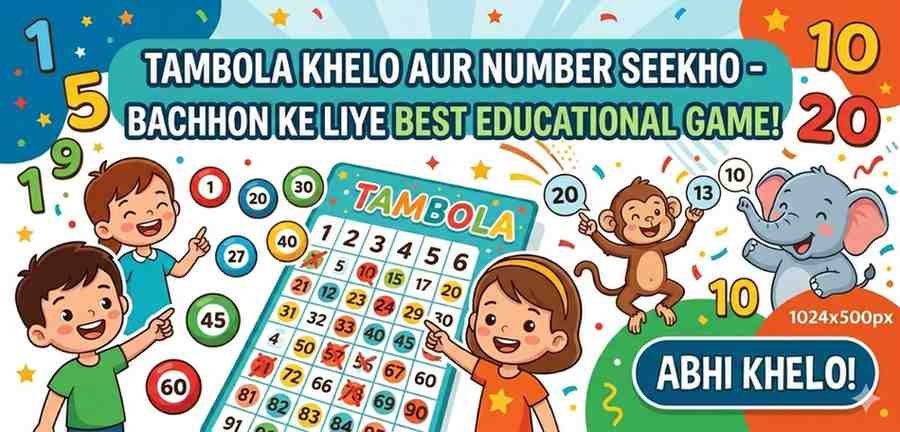
If you’ve ever watched a child struggle with numbers during homework time, you already know how frustrating that can be — for both the kid and the parent. But what if learning numbers could feel like a celebration? That’s exactly where the Tambola game for kids steps in. It’s loud, it’s exciting, and surprisingly, it teaches more than most people expect.
Tambola, also known as Housie or Bingo in different parts of the world, has been a favourite at family gatherings and festive events for generations. But lately, educators and parents have started noticing something important — this game isn’t just entertainment. When used the right way, it becomes one of the most effective tools to teach number recognition, listening skills, and concentration.
What Exactly Is Tambola and Why Should Kids Play It?
Before diving into the how, let’s understand the what.
Tambola is a number-calling game where each player holds a card (or ticket) printed with a grid of numbers. A caller randomly announces numbers one by one, and players mark them on their cards. The first person to complete a row, column, or full card shouts out to win.
Simple, right? But here’s what makes the Tambola game for kids really special — every single round forces a child to:
- Listen carefully to the number being called
- Identify it on their card quickly
- Develop number-matching speed
That’s three learning skills packed into one game, without the child even realising it’s “study time.”
How Tambola Teaches Numbers Without Feeling Like a Lesson
Most children resist sitting down with a textbook. But they’ll happily sit for 45 minutes of Tambola without complaining. That’s the magic here.
When a child plays the Tambola game for kids regularly, they start recognising two-digit numbers naturally. Numbers like 47, 83, or 12 stop feeling random — they become familiar faces. Over time, kids start anticipating numbers, mentally grouping them, and even counting how many they’ve marked.
This kind of passive number exposure is incredibly powerful for children between ages 4 and 10. It doesn’t feel like studying. It feels like winning.
H2: 7 Easy Ways to Use Tambola as an Educational Game
Let’s get practical. Here are seven real and simple ways to make the Tambola game for kids genuinely educational.
1. Start With Numbers 1 to 30 for Young Beginners
For very young children — say 4 to 6 years old — don’t use the full 1–90 range. Create custom Tambola cards using only numbers 1 to 30. This keeps the game manageable and ensures kids aren’t overwhelmed.
Print simple cards with large fonts. Use bright colours for different number ranges. Red for 1–10, blue for 11–20, green for 21–30. This also silently teaches number grouping.
2. Say the Number Out Loud AND Show It Visually
When calling numbers, hold up a number flashcard or write it on a small whiteboard. This two-channel approach — hearing AND seeing — strengthens number memory significantly.
Children with different learning styles (visual vs auditory) both benefit from this method. The Tambola game for kids suddenly becomes inclusive and more effective.
3. Ask Kids to Repeat the Number Before Marking
This one small change makes a massive difference. Before a child marks a number on their card, ask them to repeat it aloud. “What number did I call?” — “Forty-two!” — “Good, now find it.”
This builds number confidence and speaking skills at the same time.
4. Introduce Simple Addition as a Bonus Challenge
For slightly older children (8 and above), add a twist. Call out a simple addition instead of a plain number. Say “Twenty plus five” instead of “Twenty-five.” The child has to solve the sum first, then find 25 on their card.
This version of the Tambola game for kids blends arithmetic with gaming in a natural, pressure-free way.
5. Use Themed Tambola Cards for Festivals and Events
Create Tambola cards themed around festivals — Diwali, Christmas, Eid, or Independence Day. Add illustrated backgrounds, coloured borders, and exciting prizes for winners.
When children associate number games with happy occasions, they carry positive feelings toward numbers into their academic lives.
6. Play Digital Tambola on a Tablet or TV Screen
There are several child-safe apps and websites that offer interactive Tambola game for kids experiences. Playing on a large TV screen keeps the whole family involved. Numbers appear in big bold fonts, sound effects add excitement, and auto-marking helps younger children keep up.
Apps like these are especially helpful for children with attention difficulties, as the visual stimulation keeps them focused longer.
7. Let Kids Take Turns Being the Caller
This is underrated but incredibly effective. When a child calls out the numbers, they read from a slip or number token — forcing them to recognise and pronounce numbers clearly.
It builds confidence, reading ability, and number fluency simultaneously. Plus, children absolutely love being “in charge.”
H2: Benefits of Tambola Game for Kids Beyond Numbers
The Tambola game for kids is much more than a number drill. The benefits ripple outward in ways that surprise most parents.
Concentration and Patience
A full game of Tambola can last 20 to 40 minutes. Children learn to stay focused throughout. They can’t check out for even a few seconds, or they’ll miss a number. This kind of sustained attention is increasingly rare in the age of short videos and instant content.
Social and Emotional Skills
Tambola is almost always played in groups. Children learn to sit with others, respect the caller, celebrate winners without being sour, and handle the disappointment of losing with grace.
These aren’t small things. These are life skills that schools spend years trying to build.
Listening Skills
In classroom settings, listening is one of the biggest challenges. A child who regularly plays the Tambola game for kids develops sharp listening habits. They learn that missing even one word can mean missing a chance to win.
H2: Tambola Game for Kids at Home vs School — What Works Better?
Both settings offer different advantages, and honestly, both work well in different ways.
At home, the game feels relaxed. Parents can customise the rules, slow down the pace, and celebrate more warmly. A family Tambola session on a Sunday evening becomes a memorable ritual.
At school, the competitive element naturally pushes children to be sharper and faster. Teachers can use it as a ten-minute warm-up activity at the start of math class. The peer pressure (in a healthy way) motivates kids who are otherwise disengaged.
The Tambola game for kids thrives in both environments. The key is consistency — playing regularly rather than once in a while.
H2: Common Mistakes Parents Make When Using Tambola for Learning
Even a great tool can miss the mark if used incorrectly. Here are a few things to avoid.
Moving too fast: Calling numbers too quickly leaves young children confused and frustrated. Slow down. Pause between numbers. Let them search.
Making it too competitive: Prizes are fun, but if every game turns into a cutthroat competition, younger or slower children may give up. Keep the energy light and encouraging.
Playing only once: One session teaches almost nothing. Repetition is where the real learning happens. Aim for at least two to three sessions per week if your goal is genuine number literacy.
Skipping the reflection: After the game, spend two minutes asking kids which numbers they found easily and which ones they had to search for. This gentle self-reflection builds metacognitive skills.
H2: Tambola Game for Kids — Ideal Age Groups and Adaptations
Not all children will engage with Tambola the same way, and that’s perfectly fine. Here’s a rough guide.
Ages 3–5: Use picture Tambola with numbers 1–10. Replace some numbers with simple dot patterns (like dice faces) so pre-readers can participate too.
Ages 6–8: Use numbers 1–50. Add colour-coded cards. Let them use stickers or coloured beans as markers — it adds a tactile element they love.
Ages 9–12: Full 1–90 range. Introduce arithmetic calling (as mentioned earlier). Add bonus rounds for specific number facts — “Name a number between 60 and 70 that is even.”
The Tambola game for kids is flexible enough to grow with the child, which is what makes it such a lasting educational companion.
H2: How to Set Up a Basic Tambola Game at Home
You don’t need anything fancy. Here’s a minimal setup that works beautifully:
What you need:
- 3 to 6 Tambola tickets (printable online for free)
- A cloth bag or small bowl with numbered tokens (1–90)
- Small prizes — chocolates, stickers, bookmarks
Setup: Distribute tickets to players. Put all numbered tokens in the bag. The caller draws one at a time, announces the number clearly, and waits while players mark their cards. First to complete a row wins a small prize. First to complete the full card wins the main prize.
That’s it. No app, no screen, no cost. Just focused fun.
For free printable Tambola tickets, you can visit Teachers Pay Teachers where educators share classroom-ready resources. And for understanding the cognitive benefits of educational games for children, NAEYC (National Association for the Education of Young Children) offers well-researched articles on play-based learning.
Also, if you’re looking for more number-based activities for children, check out our guide on fun math activities for kids at home and our article on how to make learning tables easy for beginners.
Final Conclusion
The Tambola game for kids is one of those rare things that’s genuinely fun AND genuinely useful. In a world where screen time is high and attention spans are shrinking, this game brings children back to something simple — listening, watching, thinking, and celebrating together.
Whether you’re a parent trying to make homework less painful, or a teacher looking for a five-minute classroom energiser, Tambola fits in beautifully. It doesn’t require expertise, fancy equipment, or a big budget. It just requires a willingness to play.
Start small. Play one game this weekend. Watch what happens when a child shouts “Housie!” for the first time — the pride in their eyes will tell you everything.