 admin@playreo.in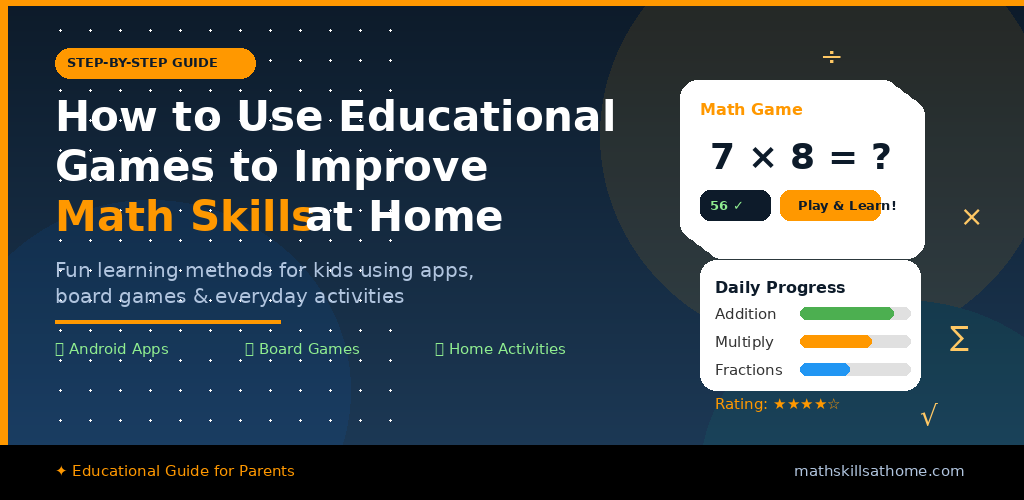
Math is one of those subjects that kids either love or quietly dread. For most, it’s the latter and honestly, that’s not always their fault. The way math gets taught in classrooms doesn’t always click with every learner. Some kids need movement, some need visuals, and some just need to feel like they’re playing, not studying.
That’s where use educational games come in. Not just any games the right kind, used in the right way, can actually shift how a child thinks about numbers. This guide walks you through exactly how to make that happen at home, step by step.
Use Educational Games Why Math Games Work Better Than Worksheets (For Many Kids)
Here’s the thing about worksheets — they signal “this is work.” The moment a child sees a row of multiplication problems, some part of their brain shuts down. It’s psychological, not laziness.
Games flip that. When a child is playing, they’re in a problem-solving mindset without realizing it. They’re calculating moves, counting points, managing resources. Math is happening, but it doesn’t feel like a lesson.
Research in learning science has shown for years that play-based learning improves retention. Kids remember what they enjoyed. If your child laughed while figuring out that 7 × 8 = 56 because they needed it to win a board game, they’ll probably remember that longer than if they wrote it twenty times on paper.
Step 1 — Use Educational Games Identify Where Your Child Actually Struggles
Before picking any game, you need to know what skill gap you’re trying to close. This matters more than people think.
Buying a multiplication-focused game for a child who hasn’t fully understood addition yet is just going to frustrate them. Same the other way — giving a 10-year-old a game meant for basic counting is going to bore them in five minutes.
Use Educational Games How to Figure This Out Without a Formal Test
Sit with your child and just have a casual conversation around numbers. Ask them to split a pizza (fractions), count change from a pretend purchase (basic arithmetic), or figure out how long until dinner if it’s 4:45 and dinner is at 6:30 (time and subtraction).
Their answers — and hesitations — will tell you a lot. You don’t need a test. You just need to observe.
Step 2 — Choose the Right Type of Game for the Skill
Not all math games are built the same. There are broadly three types you’ll be working with at home: digital app games, physical board games, and everyday activity-based games.
use Educational Games Digital App Games
These work really well for kids who are already comfortable with a phone or tablet. Apps like Prodigy Math, Khan Academy Kids, and Mathway offer structured progression — they adapt to your child’s level and keep things moving.
The good part: they’re self-paced and usually pretty engaging. The downside: screen time needs to be managed. Thirty to forty minutes a session is usually enough before attention starts drifting.
If you’re using an Android device, the Google Play Store has a solid collection of age-appropriate math learning apps. Look for ones with offline functionality too, especially if your home internet is unpredictable.
use Educational Games Board Games and Card Games
These are underrated. Games like Monopoly Junior, Sum Swamp, or even a regular deck of cards used for “War” (comparing numbers) or “21” (mental addition) are genuinely effective.
The physical aspect matters — kids engage differently when they’re holding cards, rolling dice, moving pieces. Plus, you can play alongside them, which adds a layer of connection.
use Educational Games Everyday Activity Games
This is the most flexible category. You don’t need to buy anything.
Cooking together? That’s fractions and measurement. Grocery shopping? That’s addition, estimation, and basic multiplication. A road trip? Distance, speed, time. These aren’t “games” in the traditional sense, but framing them playfully (“Can you figure out if we have enough eggs for the recipe?”) makes them feel like a challenge rather than a chore.
Step 3 — Build a Simple Routine Around Game Time
Consistency matters more than intensity. A 20-minute math game session three times a week will do more than a two-hour cram session once a month.
Set a specific time — maybe after school snack, or before dinner on weekdays. Keep it light. The goal is to make it feel like a fun part of the day, not another homework block.
What a Good Session Looks Like
Start with something easy and familiar. Let your child feel confident for the first five minutes. Then introduce the actual challenge — a slightly harder level, a new game mechanic that requires more calculation.
End on a win. Always. Even if they struggled in the middle, make sure the session closes with something they solved correctly. That feeling of “I got it” is what brings them back tomorrow.
Step 4 — Don’t Just Watch — Get Involved
One mistake parents often make is handing over the tablet or setting up the board game and then walking away. Involvement changes the experience significantly.
You don’t have to be a math expert. Just be curious alongside your child. Ask questions like “Wait, how did you figure that out?” or “What would happen if you tried it this way?” — that kind of thinking-out-loud encourages them to explain their reasoning, which is actually one of the best ways to solidify understanding.
When kids teach you something, even in a game context, they’re reinforcing what they know.
Step 5 — Track Progress Without Making It Feel Like an Evaluation
Progress tracking doesn’t mean keeping a grade sheet. It means noticing things. Did they solve that problem faster than last week? Did they figure out the change without counting on their fingers this time?
Point it out casually. “Hey, you didn’t even hesitate on that one.” That’s more powerful than a sticker chart, honestly.
If you’re using an app, most of them have built-in dashboards that show what skills are improving. Glance at those occasionally, but don’t over-focus on them. The real signal is your child’s confidence, not the app’s percentage score.
Step 6 — Mix It Up Before Boredom Sets In
No single game should run for weeks without variation. Kids get used to patterns quickly, and once a game becomes predictable, the learning slows down.
Rotate every week or two. Switch between a digital app and a card game. Add a new cooking challenge. Let your child pick the game sometimes — ownership increases engagement.
Also, don’t ignore difficulty. If a child is breezing through a game too easily, bump up the level or find a harder variation. The learning zone is slight challenge, not frustration, not coasting.
Common Mistakes to Avoid
A few things tend to trip parents up when they first start this approach:
Treating it like homework. The moment you say “you have to do your math game now,” it loses half its power. Frame it as something fun that’s just part of the day.
Choosing games by age label alone. Age ranges on game packaging are rough estimates. Base your choice on skill level, not birthday.
Expecting fast results. Learning math through games is effective, but it’s gradual. Give it four to six weeks before judging whether something is working.
Skipping the connection piece. Educational Games are better when someone plays with the child, at least some of the time. Your presence matters.
Final Conclusion
Using educational games to improve math skills at home isn’t complicated, but it does take some thought. The key is understanding your child’s specific struggles first, then picking the right kind of game for that gap — whether it’s an app, a board game, or something as simple as cooking together.
Routine and involvement matter just as much as the game itself. Thirty focused, enjoyable minutes beats a reluctant two-hour session every time. Keep it light, keep rotating, and always end on a positive note.
Math doesn’t have to be a battle. With the right approach, it can genuinely become something your child looks forward to — not every day, but often enough that it changes how they feel about numbers. And that shift in attitude? That’s really the whole point.