 admin@playreo.in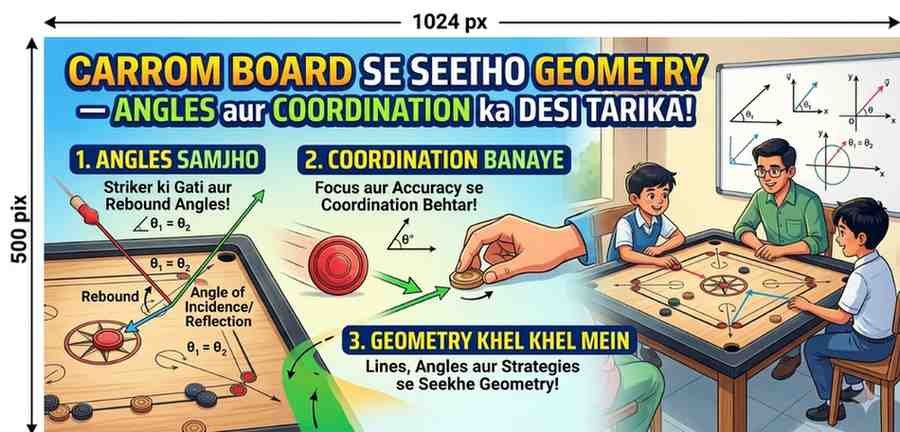
If you grew up in India, chances are a carrom board was somewhere in your house — maybe under the bed, maybe in the living room corner. You played it at family gatherings, during summer vacations, or just on lazy Sunday afternoons. But here’s something most people never noticed: every single shot you played on that board was, technically, a geometry problem. Carrom Board Se Seekho Geometry is not just a catchy phrase — it’s a genuinely useful idea. The game quietly teaches you angles, trajectories, and spatial thinking, all without opening a single textbook.
Why Carrom Is a Hidden Geometry Classroom
Most students find geometry abstract and dry. Angles on paper feel disconnected from real life. But carrom changes that.
When you sit at the carrom board, you’re instinctively calculating. You look at the position of a coin, the location of the pocket, and you adjust the angle of your striker. You don’t call it “angle of incidence” — you just call it “aim.” But it’s the same thing.
This natural process of trial-and-error is actually how geometric intuition develops. You learn it in your fingers before your brain can name it.
The Basic Geometry Behind Every Carrom Shot
Let’s start simple. Every time a striker hits a coin, energy travels in a straight line. When the striker bounces off the border, it reflects. This reflection follows a basic geometric rule — the angle at which the striker hits the border equals the angle at which it leaves. Physicists call it the “law of reflection.” Carrom players call it “the rebound shot.”
Angle of Incidence and Angle of Reflection
Hold a striker in your hand and imagine the board as a coordinate system. The border is a straight line. When your striker hits that line at 30 degrees, it bounces off at 30 degrees on the other side. This is the exact same principle taught in Class 9 and 10 geometry textbooks.
Practicing rebound shots on a carrom board gives your brain a physical, tactile experience of this concept. It sticks better than any diagram.
Carrom Board Se Seekho Geometry – Straight Lines and Trajectories
Here’s a concept that often confuses students in school: the idea of a straight line path and how objects in motion follow predictable directions.
On the carrom board, when you flick the striker directly at a coin with no spin, it travels in a perfect straight line. That path is a real-world example of a line segment — it has a start point (your finger) and an end point (the coin or pocket).
Now add some angle — tilt your shot slightly. The coin you hit moves in a different direction than the striker. That’s vector decomposition, though you’ll never hear a carrom player say that. The game teaches it anyway.
Coordination and Spatial Awareness – The Unseen Lesson
Geometry isn’t only about shapes and angles on paper. A big part of it is spatial reasoning — understanding where objects are, how they relate to each other, and predicting movement.
When experienced carrom players look at the board, they’re not just seeing coins. They’re reading a spatial map. They’re mentally calculating which coin blocks another, which angle opens a pocket, and how to position the striker for the next shot.
This is called spatial coordination, and it’s closely linked to how geometry works in real-world engineering, architecture, and design.
Why Hand-Eye Coordination Matters in Geometry Learning
Kids who play carrom regularly tend to develop better hand-eye coordination. Research in educational play suggests that physical manipulation of objects helps children understand abstract concepts more concretely.
When a child adjusts their finger angle because the coin keeps missing the pocket, they’re self-correcting based on geometric feedback. No teacher needed. No formula required. Just repetition and observation.
Real Geometry Concepts You Learn From Carrom Without Knowing It
Let’s be specific. Here are actual geometry concepts that carrom naturally teaches:
Parallel Lines: If you always shoot at the same angle from the same spot, your striker follows a parallel path each time. Players notice this when trying to clear coins in a row.
Perpendicular Angles: The corners of a carrom board are perfect right angles — 90 degrees. Shots aimed directly at a corner pocket must account for this geometry. Players naturally develop a feel for perpendicular directions.
Triangles: When you plan a shot that involves hitting one coin into another, you’re forming a triangle — striker, first coin, second coin. The angles of that triangle decide whether the second coin goes into the pocket.
Circles and Arcs: The circular striker moves across a flat surface. Spin shots create curved paths, which are arcs. Curved shot calculation is essentially applied circle geometry.
Carrom Board Se Seekho Geometry – Desi Context, Global Concept
What makes this approach genuinely special is its cultural accessibility. Not every student in India has access to a well-equipped math lab or expensive geometry tools. But a lot of families have a carrom board.
Carrom Board Se Seekho Geometry brings world-class conceptual learning into a familiar, low-cost setting. A second-hand carrom board costing ₹300 from a Sunday bazaar can teach the same spatial reasoning that a ₹5,000 geometry kit claims to offer.
This is the real power of desi learning methods — they meet students where they already are.
How Teachers and Parents Can Use This Approach
If you’re a teacher or parent, this concept has practical classroom and home applications.
Ask your child to explain why a rebound shot works. Don’t give the answer — let them describe what they see. You’ll be surprised how close they get to the textbook definition of reflection.
Set up a small challenge: place a coin in a corner and ask the child to hit it using a rebound off the border — not a direct shot. They’ll spend 15 minutes experimenting with angles, completely unaware they’re doing geometry.
Simple Experiments to Try at the Carrom Board
- Place a coin directly in front of a pocket. Ask: what’s the straightest angle to pocket it?
- Put the coin at 45 degrees from a pocket. Try a direct shot vs. a rebound. Observe the difference.
- Use chalk to draw a line on paper and mark angles before shooting — then compare with actual results.
These exercises work well for students aged 9–16 and can be tied directly to NCERT geometry chapters on lines and angles.
The Bigger Picture – Play as a Learning Tool
There’s a growing body of educational thought that supports game-based learning. Carrom fits naturally into this framework. It’s competitive, engaging, and deeply rooted in Indian culture.
The concept of Carrom Board Se Seekho Geometry isn’t just a clever idea for a blog post. It represents a shift in thinking — that learning doesn’t require formal setups. Sometimes it just requires a flat wooden board, a few plastic coins, and curiosity.
If you want to explore more about geometry through everyday objects, this article on real-world math applications and this guide from NCERT’s learning resources both offer useful extensions for students and educators.
Final Conclusion
Geometry often feels like it belongs to the classroom — cold, abstract, difficult to visualize. But carrom proves otherwise. Every flick of a striker, every rebound off the border, every carefully angled shot is a geometry problem in disguise.
Carrom Board Se Seekho Geometry isn’t about making the game complicated. It’s about recognizing what was always there — a desi, practical, and beautifully intuitive way to understand the world of shapes, angles, and motion. Whether you’re a student struggling with geometry or a teacher looking for fresh ideas, the carrom board might just be the best teaching tool you already own.
Pick it up. Play a few rounds. And the next time someone asks you what angle of reflection means — show them the board.